Exponentials and indices
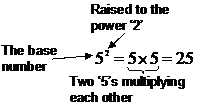
When you raise a number to a power, you’re specifying how many times to multiply that number by itself. So for instance, if I have the number ‘5’, and I raise it to the power ‘2’, I’m saying that there should be two ‘5’s multiplying each other:

Sponsored Links
There are proper mathematical terms we can use to describe each of the bits in the equation above.
The base is the number which is being raised to a power, the number that has the little index number written above it. It’s the number that is being multiplied by itself a certain number of times. In this example, ‘5’ is the base.
The exponent or index number is the little number above the base, it tells you what power the base is being raised to. In this example, the exponent is ‘2’.
The number in decimal notation is just the number that the expression evaluates to – for our example, five squared is equal to twenty-five – ‘25’ is how we write it in decimal notation.