Different forms of linear equations
We’ve seen linear equations before, where all of the pronumerals in the equation are raised to the power 1:

Sponsored Links
The general form of a linear equation is this:

‘a’, ‘b’ and ‘c’ are just numbers, ‘x’ and ‘y’ are the two variables or pronumerals. So the general form of the equation before would be:

Now for working out problems, and also for plotting graphs, it’s usually easiest to have a linear equation in the gradient-intercept form, like this:

Our equation was already listed in the gradient-intercept form at the beginning of this section:
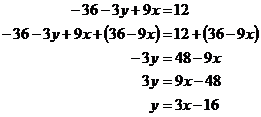
In general, to get a linear equation into the gradient-intercept form, you need to get ‘y’ (or whatever the equivalent variable or pronumeral is) by itself on the left hand side of the equation, with a coefficient of ‘+1’. This is how I would get this following equation into gradient-intercept form: