There are two special types of vectors which have a magnitude of 1 – a vector pointing in the positive x-axis direction, and one pointing in the positive y-axis direction. The one pointing in the positive x-axis direction is called ‘i’, the one pointing in the positive y-axis direction is called ‘j’:
 ,
,

Sponsored Links


Unit vectors are often drawn with a little hat above them, like this:


You can usually assume that ‘i’ or ‘j’ vectors are unit vectors, whether they have the hat or not. We can use these unit vectors to describe any vector in this coordinate frame. For instance, this vector:
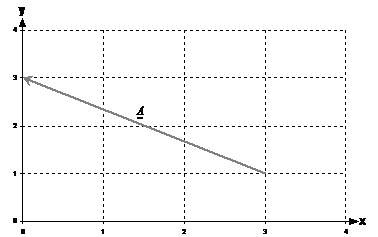
To describe this vector, we need to look at how many unit vectors in each direction it goes. For instance, in the horizontal direction, the vector travels three units to the left, starting at x = 3 and going to x = 0. In the vertical direction, the vector travels two units upwards. So we can write a description of our vector by describing how we could make it up with unit vectors:

Notice how it’s negative three . This is
because the unit vector points in the positive x-axis
direction. Because our vector points in the negative direction horizontally, we
need to use negative amounts of the vector to describe it.