Sponsored Links

Most Popular Tutorials

3D Shapes

More 3D Shapes and Shape Nets. Learn about pyramids and solid shape nets.

Math-Mate.com/3DShapes

The Cosine Rule

Learn all about the cosine rule for triangles. Includes an example worked question.

Math-Mate.com/CosineRule

Frequency Polygons

Learn all about frequency polygons. Learn how to make one to display information.

Math-Mate.com/FrequencyPolygon

Index Laws

Learn all about index laws. Learn how indices change under multiplication and division.

Math-Mate.com/IndexLaws

The Chain Rule

The best way to demonstrate this is by example.

Chain rule question

Find the derivative of this function with respect to x:


Solution

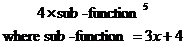
Note that this function can be split into two functions:


If we let that sub-function = u, or any letter we want, we can rewrite the function as:

                                                             y = 4u5

                                                      where u = 3x + 4

All the chain rule says is that


In words, this says the derivative of y with respect to x is equal to the derivative of y with respect to u times the derivative of u with respect to x.  Note if you cancel out the ‘du’s on the right hand side, you are left with the left hand side.

Now:


And:


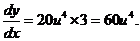
So we can use our differentiation rules to calculate that


We can then substitute in for what u is and give the answer as

                                                          60(3x + 4)4

Here’s another example question with trigonometric ratios.

Chain rule question

Find the derivative of this function with respect to x:


Solution

Let u = 3x2 + 2x + 3.

Then the function becomes y = cos u.

Now:


Let’s work out what each bit equals:


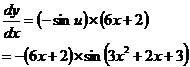
And put it all together: