There are other operations you can do apart from multiplication, division, addition and subtraction.
Square operation
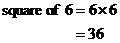
You can find the square of a number by multiplying it by itself. For example, the square of 6 can be found by doing:
Cube operation
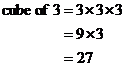
The cube of a number can be found by multiplying it by itself twice. For example, the cube of 3 can be found by doing:
Square root
The square root operation is the opposite of a square operation. To find the square root of a number, you need to find two identical values that multiply together to give that number. A simple example of this is:
Find the square root of 4
I’ve got to think of two identical numbers that when multiplied together, give me 4.
What about 1 and 1?

This doesn’t give me 4
What about 2 and 2?

So the square root of 4 is 2. Most numbers don’t have nice square roots. For instance, if you try and find the square root of 7, by typing it into your calculator, you should get something like:
2.6457513
The numbers that do have nice square roots are the perfect square numbers – 1, 4, 9, 16, 25, 36, 49, 64, and so on…
The square root operation has a special symbol:

So if I wanted to write the square root of 16 for instance, I’d write:

The number you’re square rooting goes under the horizontal line. If you’re finding the square root of a more complicated expression, you may need to extend the length of the horizontal line, for instance:

Using your calculator – square root
Find the square root of 17.
|
|
|
|
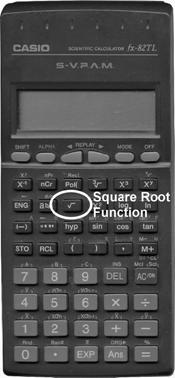
Press the square root symbol; it should appear on your screen. Type in ‘17’, it should appear to the right of the square root sign Press the ‘=’ button You should get 4.123105626 on your screen. |
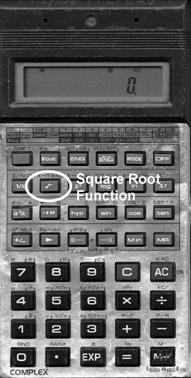
Type in ‘17’; it should appear on your screen. Press the square root button. You should get 4.1231056 on your screen.
|
Inverse operations
These are operations which are the opposite of each other. For instance, addition and subtraction are inverses of each other. Why is this? Well, look at this simple example:
Start with the number 4:
4
Now add 3 to it:
4 + 3 = 7
Now let’s do the inverse of adding 3, which is to subtract 3:
7 – 3 = 4
We end up with our original number. When you do two operations in a row that are the inverse of each other, you end up with the original number. Multiplication and division are also inverse operations:
Start with 5
Multiply it by 3
5 × 3 = 15
Now divide it by 3
15 ÷ 3 = 5
We end up with our original number again.
The square and square root operations are also inverses of each other for positive numbers. Say I take 5:
5
And square it:
5 × 5 = 25
And then find the square root of it:
