Often a question will say whether each input is true or false and then ask you to evaluate the overall output and come up with a single true or false answer. In this case, let’s try evaluating the answer for:
x = true, y = false, z = true
The brackets work the normal way – you start from the
expression inside the innermost brackets and work your way outwards. The  one becomes
  , which we know
is false –
, which we know
is false –  .
.
The  expression becomes
  . This is an OR
statement, so if any of the statements are true, then the whole thing is
true. In this case we’ve got two true statements in it, so the whole thing
becomes true –
. This is an OR
statement, so if any of the statements are true, then the whole thing is
true. In this case we’ve got two true statements in it, so the whole thing
becomes true –  .
.
The  is an AND statement. This means
that all the statements have to be true for the whole thing to be true.
Otherwise the whole thing is false. In this case, we’ve got
is an AND statement. This means
that all the statements have to be true for the whole thing to be true.
Otherwise the whole thing is false. In this case, we’ve got  – all the
elements are true. So the whole thing is going to be true –
– all the
elements are true. So the whole thing is going to be true –  . So we can
simplify it a bit down to this:
. So we can
simplify it a bit down to this:

Now there are only a couple more steps. First simplify
the bit inside the left brackets. We’ve got  . Since there are no brackets
around this, we can do it in any order, I’m going to do it from left to right.
So first the
. Since there are no brackets
around this, we can do it in any order, I’m going to do it from left to right.
So first the  bit
– this is an AND connector, so the outcome is false. So we get:
bit
– this is an AND connector, so the outcome is false. So we get:

Now we deal with the second AND statement – the outcome of this is false as well:

So that’s simplified the left square brackets down to a single ‘false’. We’ve got one last step:

This is an OR statement, so we only need one of the statements to be true for the whole thing to be true. So the overall answer is ‘true’:

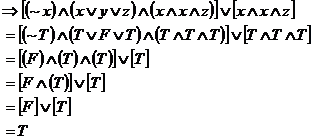
Here’s a summary of how it went down: